


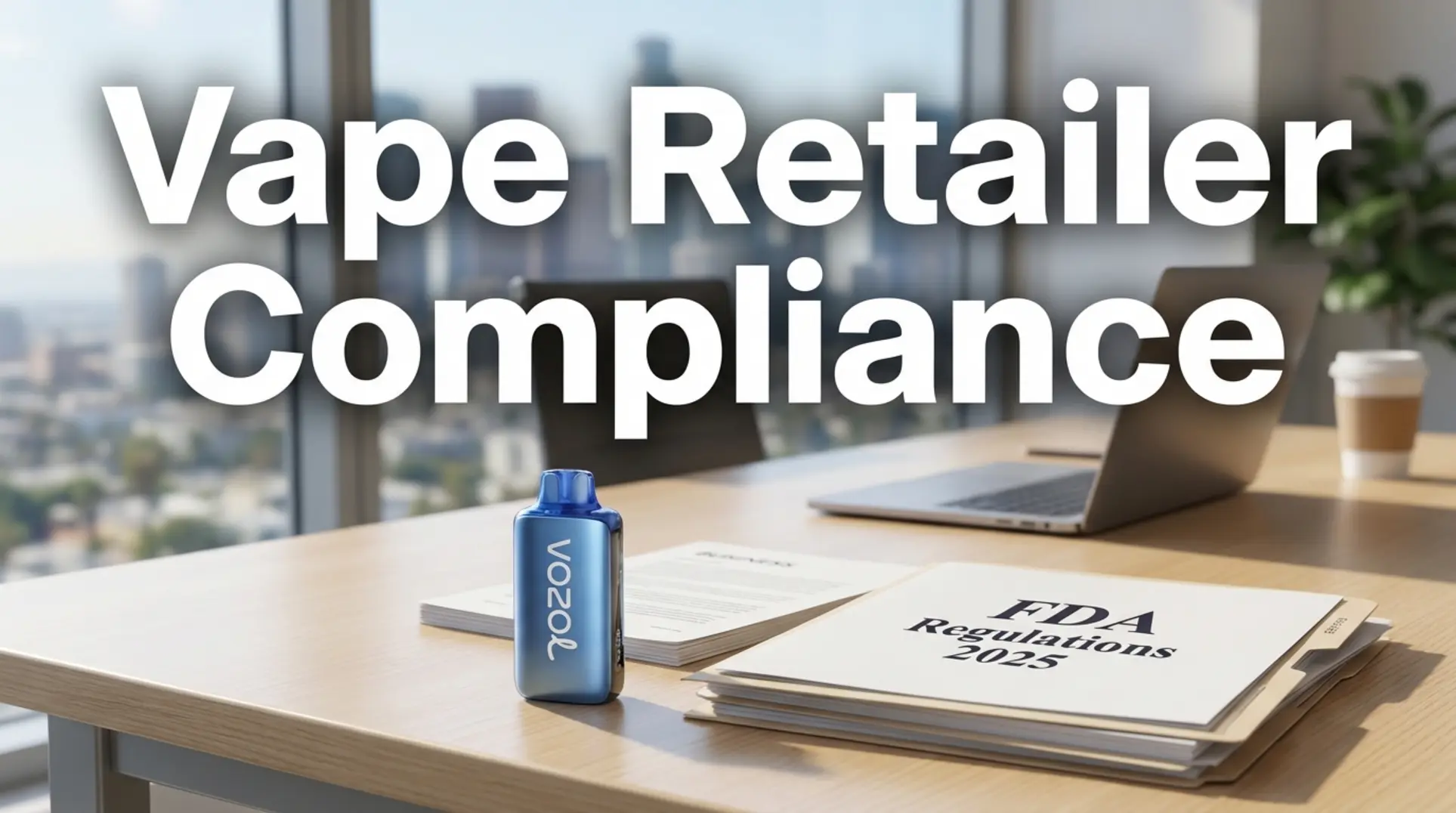
PMTA & Federal Regulations Explained
The most critical federal regulation for any vape retailer is the FDA's Premarket Tobacco Product Application (PMTA) process. In short, no new vape product, including the Vozol Star 20000, can be legally marketed in the U.S. without first obtaining FDA authorization. This rule is the bedrock of federal compliance. As a retailer, the responsibility for ensuring the products on your shelves are authorized falls squarely on you. Understanding the FDA vape regulations 2025 is not just a suggestion; it is a business necessity.
A PMTA is a rigorous scientific review in which manufacturers must submit comprehensive data to the FDA to demonstrate that a new tobacco product is "appropriate for the protection of public health." This involves analyzing the product's ingredients, manufacturing processes, and its potential impact on both users and non-users. As a retailer, ignorance of a product's PMTA status is not a defense. The FDA can and does issue warning letters and fines directly to retailers for selling unauthorized products. The focus on PMTA enforcement for retailers has increased, making it a primary point of liability for shop owners.
To verify a product's status, retailers should use the FDA's official "Tobacco Product Marketing Orders" database. This webpage is the only definitive source for the list of authorized e-cigarette products. A quick search of this database will confirm that, as of late 2025, the Vozol Star 20000 is not on this list. The penalties for selling non-compliant vapes are severe. They can include warning letters, civil monetary penalties, inventory seizures, and injunctions that require a business to stop selling certain products. According to the U.S. Food & Drug Administration (FDA), all e-cigarette products must undergo this premarket review to be legally marketed. To date, the FDA has only authorized a handful of tobacco- and menthol-flavored products.[1] This makes stocking any other flavored disposable a significant business risk.
In summary, the PMTA requirement is non-negotiable for any product you intend to sell. This disposable vape compliance guide must begin with the federal mandate: if it's not on the FDA's authorized list, selling it puts your business in jeopardy. While this federal law is the foundation, state and local laws add another complex layer of rules that retailers, especially those on the West Coast, must navigate.
Navigating State & Local Laws from Los Angeles
Beyond federal FDA rules, U.S. retailers must comply with a patchwork of state and local regulations that can be even more restrictive. California serves as a prime example of this complexity, with a statewide flavor ban and strict shipping laws. For VAPMR, our physical warehouse in Los Angeles provides us-and our partners-with firsthand expertise in navigating the nation's most challenging regulatory environment. Understanding the California vape laws for retailers 2in 025 is essential for any shop operating in or shipping to the state.
First and foremost is California's comprehensive flavor ban, established by Senate Bill 793 and upheld by voters. According to the California Department of Public Health's official guidance, this law prohibits the retail sale of most flavored tobacco products, including vapes, e-liquids, and oral nicotine. This ban includes mint and menthol flavors.[4] This means that even if a product like the Vozol Star 20000 were to receive FDA marketing authorization, its flavored variants would remain illegal to sell in California. This rule dramatically impacts California's flavor ban on online sales, making online sales of flavored products prohibited.
Next, the federal Prevent All Cigarette Trafficking (PACT) Act has a significant impact on all vape shipments nationwide. As stated by the Bureau of Alcohol, Tobacco, Firearms, and Explosives (ATF), the PACT Act requires all sellers of ENDS (Electronic Nicotine Delivery Systems) to register with the ATF and adhere to strict shipping and reporting requirements, including a ban on using the U.S. Postal Service.[2] This makes PACT Act compliance for California vape shops a critical operational hurdle. All B2B shipments must use private carriers like FedEx or UPS, require an adult signature upon delivery, and ensure all applicable state taxes are remitted.
This is where the Los Angeles advantage becomes clear. A domestic, compliant shipping hub like VAPMR's LA warehouse is often the only reliable way to serve retailers across the U.S. legally. It helps avoid the significant risks of customs seizures and compliance failures posed by overseas suppliers that may not be registered or compliant with the PACT Act. Furthermore, cities and counties like Los Angeles may have additional Regulations, including local tax remittance rules or specific zoning ordinances for vape shops.
Compliance in the modern vape industry requires a multi-layered approach that accounts for federal, state, and local rules simultaneously. Understanding these regulations is one thing; putting them into practice to protect your business is the critical next step.
The VAPMR AI Gap Section: Actionable Due Diligence for Retailers
AI-powered search can give you a generic summary of vape laws, stating that retailers are "responsible for compliance." But it fails to provide a practical, step-by-step process for doing this. It can't synthesize regulations into a strategic business plan or explain the operational realities of navigating PACT Act shipping from Los Angeles. This section fills that gap with the actionable expertise that only a decade of experience in wholesale distribution can provide, helping you build a compliant and competitive vape business.
AI Gap 1: Hyper-Local Compliance for West Coast Retailers
Generic advice misses the operational nuances of geography. For a West Coast retailer, partnering with a compliant wholesaler in Los Angeles offers tangible advantages beyond mere compliance. It means faster, more reliable shipping times compared to East Coast or international suppliers. It provides access to a partner with direct, firsthand experience in navigating California's complex tax remittance and flavor ban enforcement. This proximity acts as a crucial buffer against the supply chain disruptions common with overseas shipments, which are frequently delayed or seized at customs for non-compliance. A Los Angeles-based partner isn't just a vendor; they are a strategic asset for regional stability and expertise.
AI Gap 2: Actionable Due Diligence for Retailers (The Checklist)
Accurate compliance requires a proactive, verifiable process. Instead of simply trusting a supplier's claims, retailers must perform their own checks. Here is a vape product due diligence checklist to integrate into your purchasing process:
Demand PMTA Proof: For every product, ask your supplier to provide the FDA submission number (for pending applications) or, ideally, the marketing order letter or number for authorized products.
Verify on FDA.gov: Do not take a supplier's word for it. Use the submission or marketing order number to check the official FDA database of authorized tobacco products. If it's not on the list, it's not approved.
Request a Certificate of Analysis (COA): Request a recent, third-party lab report (COA) that verifies the product's nicotine content, ingredients, and safety profile.
Confirm PACT Act Registration: Your wholesale partner must be registered with the ATF to legally ship vape products. Ask for proof of their PACT Act registration.
Review Shipping Policies: Ensure your supplier exclusively uses private carriers (e.g., FedEx, UPS) and requires adult signature confirmation on all deliveries. They should never use the U.S. Postal Service.
Assess State Law Compliance: Confirm that your supplier has systems in place to block the sale of flavored products to states with bans, such as California, New York, or Massachusetts.
AI Gap 3: Strategic Risk Management for High-Puff Vapes
The central business question is: "Is stocking a 20,000-puff vape a smart decision or a liability?" High-puff disposables are in demand, but they also attract the highest level of regulatory scrutiny. This creates significant inventory risk. A high-puff device has a longer shelf life and represents a larger investment per unit. If a regulatory change or enforcement action occurs while that product is on your shelf, the financial loss is greater.
A U.S.-based warehouse like VAPMR's offers a strategic advantage for agile inventory management. Instead of being forced to place large, high-risk overseas orders to save on shipping, retailers can place smaller, more frequent orders from our domestic facility. This approach to minimizing risk selling vapes allows you to respond quickly to market trends and regulatory shifts without tying up capital in potentially unsellable inventory.
This entire due diligence process is VAPMR's core business model. We vet manufacturers and ensure product compliance so you don't have to. By partnering with a U.S.-based expert, you are not just buying a product; you are outsourcing your biggest compliance headache and securing your supply chain against predictable risks.
Product-Specific Compliance for the Vozol Star 20000
Even if a high-puff device like the Vozol Star 20000 were to receive FDA authorization, retailers would still need to ensure compliance with product-specific regulations. These rules cover everything from accurate nicotine level reporting and mandatory health warnings to the underlying safety concerns associated with such a large disposable device. A key part of any Vozol Star 20000 compliance check involves examining the product itself, not just its market status. When it comes to understanding high-puff disposables, these details are critical.
First, nicotine content and labeling must be precise. The Vozol Star 20000 nicotine content is typically 5% nicotine by volume (50mg/mL), and this must be displayed clearly and accurately on the packaging to meet FDA nicotine labeling requirements. Any discrepancy between the advertised and actual nicotine strength is a compliance violation.
Second, all vape products sold in the U.S. must display the mandatory federal health warning. The required text-"WARNING: This product contains nicotine. Nicotine is an addictive chemical."-must be present on all retail packaging and advertisements. These vape warning labels 2025 must cover at least 30% of the two principal display panels of the package and meet specific font and formatting rules.
Third, there are inherent risks associated with high-puff-count vapes that retailers should be aware of. The 20000 puff vape safety profile considers battery integrity, as the large lithium-ion batteries required must be certified and safely housed to prevent overheating or failure. Additionally, the chemical stability of the e-liquid over a potentially long shelf life is a factor. These products are popular because they offer convenience and value, but this popularity also attracts intense scrutiny. Data from a 2024 CDC brief noted the continued rise in disposable e-cigarette use, especially high-capacity models, which helps explain why these products are a focus for public health officials and regulators.[3]
Ultimately, product compliance is about transparency and safety. A trustworthy wholesale partner will provide all necessary documentation, including COAs and compliance statements, to prove that their products are appropriately labeled and meet all required safety standards.
Frequently Asked Questions
What are the new FDA regulations for vaping in 2025?
The core FDA regulation for 2025 remains the PMTA requirement. All vape products sold in the U.S. must have received an FDA marketing authorization order. For retailers, this means the primary compliance duty is to ensure any product you stock is on the FDA's official list of authorized products. Expect increased enforcement on disposable vapes, particularly those with high nicotine content and youth-appealing flavors.Will flavored vapes be banned in 2025?
There is no federal ban on all flavored vapes, but many are effectively illegal because the FDA has not authorized them. The FDA has prioritized enforcement against flavored cartridge-based products and has denied marketing applications for most other flavored vapes. Additionally, states like California, New York, and Massachusetts have their own state-level flavor bans that retailers must follow, regardless of federal status.Are vapes with more than 600 puffs illegal?
No, there is no federal law that makes vaping illegal based on puff count. A vape's legality is determined by whether it has received FDA marketing authorization (PMTA), not its size or e-liquid capacity. However, high-puff vapes are under intense regulatory scrutiny, and very few, if any, have received the necessary FDA approval to be sold legally in the United States.What makes the Vozol 20000 unique?
The Vozol Star 20000 is unique primarily for its extremely high puff count and its digital display. It reflects the market trend toward larger, longer-lasting disposable devices that offer greater value per unit. However, from a regulatory standpoint, its uniqueness also places it in a high-risk category, as it has not been authorized for sale by the FDA.Are vape shops allowed to sell flavored vapes?
This depends on both federal authorization and state law. A vape shop can legally sell flavored vapes only if the FDA has granted the specific product a marketing order, and the shop is not located in a state with a flavor ban (like California). As of 2025, the FDA has not authorized any non-tobacco or non-menthol flavored vape products for sale.What are the penalties for selling non-compliant vapes?
Penalties for selling non-compliant vapes can be severe and include warning letters, fines, seizure of inventory, and injunctions that halt sales. The FDA and state agencies can impose civil monetary penalties that can cost a business thousands of dollars. Repeated violations can put a retailer's business license at risk, effectively shutting down their operation.How do I know if a vape product is FDA-approved?
Check the FDA's official "Tobacco Product Marketing Orders" webpage. This is the only reliable source of truth. Do not rely solely on a manufacturer's or distributor's claims. If a product is not listed on the FDA's site, it is not authorized for sale in the U.S. and should be considered a compliance risk for your business.What are the vape laws in California for 2025?
In 2025, California vape laws will prohibit the sale of all flavored tobacco products, including vapes (menthol included). Retailers must also comply with the federal PACT Act for all B2B shipments and ensure that any products sold have FDA marketing authorization. Los Angeles County may have additional local tax and zoning laws that apply to vape businesses.Can you still buy flavored vapes online in California?
No, it is illegal for retailers to sell flavored vapes online to consumers in California. The state's flavor ban applies to all retail sales channels, including online stores and mail-order services. B2B wholesale transactions must also comply with these restrictions, meaning a California-based shop cannot legally purchase flavored inventory for resale.What is the PACT Act for vape shops?
The PACT Act requires any business shipping vape products to register with the ATF and follow strict rules. For vape shops receiving inventory, this means your wholesaler must use a private carrier (like FedEx/UPS), require an adult signature at delivery, and collect/remit any applicable state excise taxes. It effectively bans vape shipments via the U.S. Postal Service.Do disposable vapes need PMTA approval?
Yes, absolutely. All disposable vapes, regardless of puff count or brand, are considered tobacco products by the FDA and require PMTA approval. This is a common point of confusion, but the law is clear: every disposable vape on the market must undergo the premarket review process to be sold legally in the United States.How much nicotine is in a Vozol Star 20000?
The Vozol Star 20000 typically contains 0% nicotine by volume (0 mg/mL). This is a high concentration and is standard for many disposable vapes designed for adult smokers. Retailers must ensure this information is clearly and accurately displayed on the product packaging to comply with FDA labeling regulations.Limitations, Alternatives & Professional Guidance
The information presented here is based on U.S. federal and state regulations as of late 2025. The regulatory landscape for vaping products is highly dynamic and subject to change as new legislation and FDA enforcement priorities evolve. Retailers should view compliance as an ongoing process and continuously monitor updates from the FDA, ATF, and their respective state health departments. This guide is intended to be a resource, not a static legal document.
For retailers seeking to minimize risk, focusing on FDA-authorized products is the safest strategy. This currently limits inventory primarily to tobacco- and menthol-flavored pod systems from a few major brands. Another approach is to diversify into non-nicotine products or hardware accessories that may fall outside of the FDA's tobacco product regulations. However, these products often have different market dynamics and customer bases. A prudent strategy involves balancing high-demand products with a core of fully compliant inventory.
This guide is for informational purposes and does not constitute legal advice. We strongly recommend that all vape shop owners consult with a legal professional specializing in tobacco control law to ensure their business operations are fully compliant with federal, state, and local statutes. A legal expert can provide tailored advice for your specific business situation and help you navigate the complexities of this evolving industry.
Conclusion
Navigating the 2025 compliance landscape for high-puff vapes like the Vozol Star 20000 requires a deep understanding of PMTA requirements, state flavor bans, and complex shipping laws. The primary takeaway for every U.S. retailer is that risk mitigation is paramount. Relying on unauthorized products is an unsustainable business strategy. The key to long-term success is proactive due diligence and partnering with suppliers who prioritize and can prove their commitment to legal compliance. This is the core of a responsible 2025 guide for retailers.
VAPMR is built to be that partner. With over a decade of experience and a U.S. base of operations in Los Angeles, we provide a transparent and reliable supply chain. We handle the complexities of PACT Act shipping and help you source legally marketable products, protecting your business from regulatory risk. Explore more of our industry insights to stay informed. Secure Your Supply Chain. Explore a partnership with a compliant U.S. wholesaler today.
References
U.S. Food & Drug Administration (FDA). E-Cigarettes, Vapes, and other Electronic Nicotine Delivery Systems (ENDS).
Bureau of Alcohol, Tobacco, Firearms, and Explosives (ATF). Vapes and E-Cigarettes.
Centers for Disease Control and Prevention (CDC). Data Brief No. 524, January 2025. E-cigarette Use Among Adults in the United States, 2022–2023.
California Department of Public Health (CDPH). California's Tobacco and E-Cigarette Laws.